
Outsourcing E-Commerce Logistics: Key Considerations for 2026
Actual costs, SLAs, WMS, returns management, termination clauses: Here is the evaluation checklist to use before entrusting your e-commerce logistics to a service provider.
Choosing a partner to outsource your e-commerce logistics will impact your profit margin, delivery times, and brand reputation for several years. Between turnkey fulfillment solutions, generalist 3PLs, and providers capable of managing the entire supply chain, comparing options can quickly become a headache.
The criteria to consider go far beyond the cost of order fulfillment. This guide provides a comprehensive evaluation framework—from warehouse networks to contractual terms—to help you make a well-informed decision in 2026. At D&fi Groupe, we support retailers taking this step from Roissy CDG.
Why Outsource Your E-Commerce Logistics?
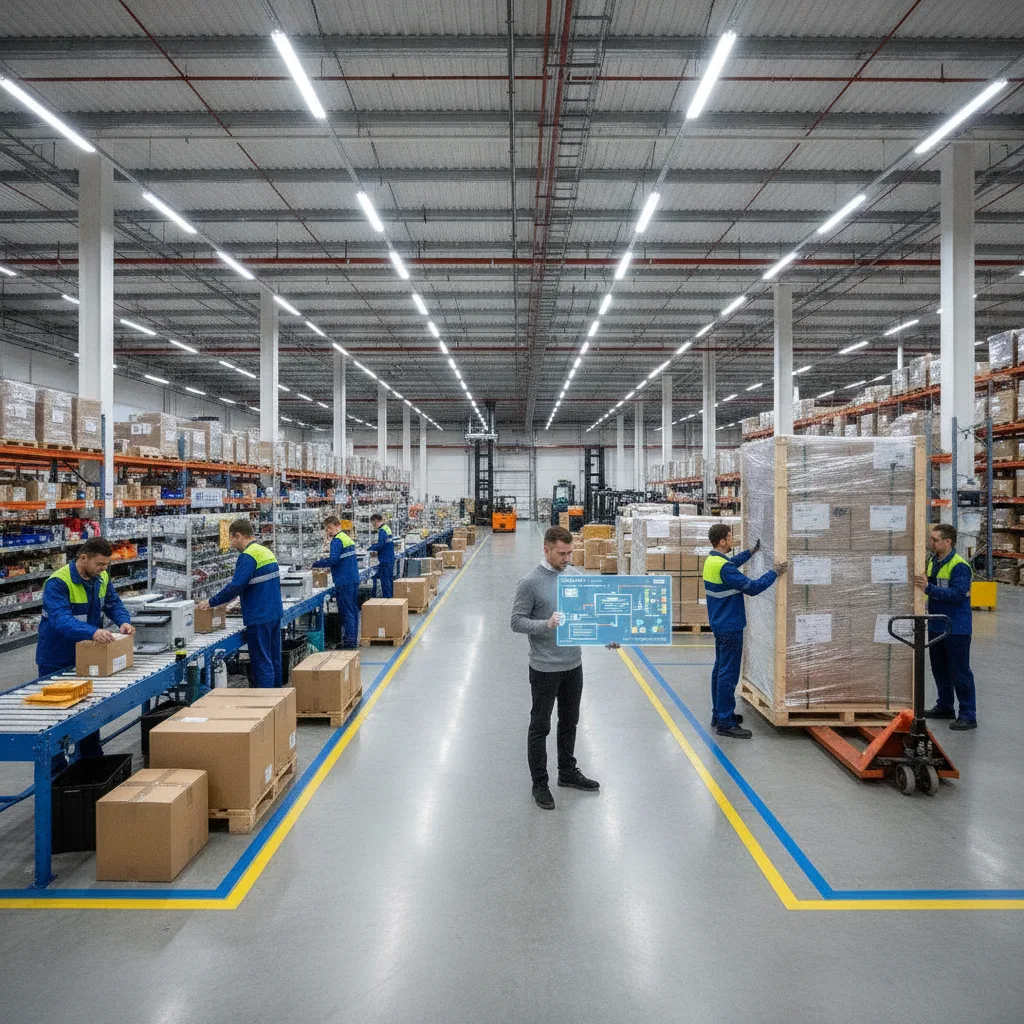
Outsourcing isn’t just a way to save money. First and foremost, it involves transferring operational responsibility to an e-commerce logistics provider. This provider has a warehouse, a WMS (Warehouse Management System), teams trained in picking and packing, and a network of carriers with whom it has negotiated rates.
In practice, you're buying three things.
Physical capacityStorage space, staff, and equipment that you don't have to pay for yourself.
Measurable reliabilityDocumented processes and performance metrics tracked over time.
Flexibility During Peak PeriodsProcessing capacity that adapts to seasonal spikes in activity.
A retailer who handles order fulfillment on their own will quickly reach a limit. Either there isn't enough space, or the time spent on packaging is no longer being invested in sales and the product.
Another benefit—one that is often underestimated—is the customer experience. A high order-fulfillment error rate, a poorly packaged package, or a return that takes three weeks to process costs far more than a billing line item. Logistics has become a key competitive differentiator, just like price or customer service.
When should you outsource, and at what volume?
There is no universal threshold, but there are converging indicators. Industry experts use a simple guideline: when logistics take up more than two hours a day or when a significant seasonal increase is on the horizon, outsourcing becomes a viable option.
There are other triggers as well:
- the launch of a new sales channel, such as Amazon Marketplace or Mirakl;
- international expansion;
- the arrival of a bulky or regulated item;
- a warehouse relocation that would require you to make a new investment.
Document your needs before consulting
- Average Monthly Volume
- Amplitude of Seasonal Peaks
- Nature of the Products
- Delivery time promised to the customer on your website
- Observed Return Rate
- Priority Delivery Areas
Without these elements, any comparison of e-commerce logistics providers is meaningless, since each provider will base its calculations on different assumptions. This framework also allows you to assess whether the provider truly understands your business model.
Outsourcing E-Commerce Logistics: What Factors Should You Consider Before Signing a Contract?
The table below covers the criteria that consistently appear in serious requests for proposals. It applies equally to e-commerce logistics outsourcing for an SME as it does to an established brand.
Location, warehouse network, and geographic coverage
The warehouse’s location determines your delivery times and shipping costs. Outsourced e-commerce warehousing located near air hubs and major highways shortens the cutoff time—that is, the deadline for handing over packages to the carrier. This allows you to shave a day off your promised delivery time.
Ask the service provider about the number of locations, available space, warehouse network, and actual geographic coverage in your target markets. If you ship to French overseas departments and territories or internationally, verify their expertise in Incoterms and customs formalities, as well as whether they have local partners.
Our location at Roissy CDG and our status as an Authorized Economic Operator are in line with this strategy of proximity to air and maritime traffic.
Technical Integrations, WMS, and API Connector
Integration with your e-commerce CMS is the most common point of failure. Ask whether the connector for Shopify, PrestaShop, or WooCommerce is native or requires custom development. Also check:
- if the API is documented;
- if real-time inventory synchronization is working properly;
- if import errors trigger an alert.
A good service provider offers a logistics dashboard to track inventory, orders, shipments, and issues without having to follow up with a contact via email. Finally, make sure the system can simultaneously manage your B2C, B2B, and marketplace workflows, and that your data remains exportable. This is essential for future flexibility.
Lead Times, SLAs, and Order Fulfillment Error Rates
A business commitment without a written SLA (Service Level Agreement) is worthless. Industry standards typically call for order fulfillment within 24 to 48 hours, depending on the promise displayed on your store’s website. If the timeframe is exceeded, ask the service provider for actual performance metrics from the past twelve months—not just their sales targets.
Here are the KPIs you should ask for before signing any agreement. They provide an objective basis for your comparison.
- Order Compliance Rate and Picking Error Rate
- Average time between order receipt and shipment
- Rate of damaged packages and out-of-stock rate attributable to inventory discrepancies
- Rate of returns processed within the agreed timeframe and logistics complaint rate
- Timeframe for Receiving and Storing Incoming Goods
- Support Availability and Response Time
Also ask for several client references that are comparable by industry, product type, volume, and sales channels. A certification such as ISO 9001 attests to a structured quality management system, but it is no substitute for verifying the numbers and feedback from the field. These supply chain performance metrics must be clearly outlined in your comparison grid.
Returns Management and Customer Experience
The management of e-commerce returns by a service provider should be viewed as a comprehensive process: receipt, quality control based on a defined checklist, classification, restocking, repackaging, disposal, or reshipment.
Clarify who decides on restocking and how incomplete or damaged products are handled. Ask whether inspection photos are provided, whether exchanges are automated, and whether a returns portal is available to your customers. These factors are critical in the fashion, leather goods, and cosmetics industries, where the return rate directly impacts profitability.
Custom packaging—or the unboxing experience—deserves the same attention. Branded inserts, tissue paper, recycled or lightweight options: all of these are negotiated in advance and factored into the order total. Also specify who will handle customer inquiries regarding tracking and disputes—your customer service team or the service provider’s.
Total Cost: How to Compare Two Quotes Without Hidden Fees
Comparing only the cost of order picking is the surest way to make a mistake. The total logistics cost, or TCO, is calculated item by item and then projected over twelve months based on three scenarios: average activity, seasonal peaks, and temporary declines in sales. Don’t forget to include your current internal costs: salaries, rent, equipment, supplies, software, and the time spent by your teams.
| Cost center | What it covers | Point to Watch For |
|---|---|---|
| Receipt of Goods | Unloading, inspection, and inventory entry | Billing by pallet, by box, or by item |
| Storage | Pallet location, shelf, or occupied space | Monthly or daily calculation basis, idle inventory |
| Preparation | Picking, packing, supplies, and packaging | Volume discount per additional line |
| Shipping | Handover to the carrier, labeling, and shipment tracking | Fuel Surcharges and Remote Area Surcharges |
| Returns | Receipt, inspection, restocking, or disposal | Fixed or variable price depending on the product's condition |
| Incidental expenses | Integration, Inventories, Special Operations | Minimum Monthly Billing Amount and Stock Withdrawal Fees |
Hidden costs in e-commerce logistics almost always fall into three categories: minimum billing amounts, one-time services billed by the hour, and inventory transfer fees at the end of the contract. Insist on a detailed, itemized quote and a clear pricing index. For a new business or one with irregular volumes, the absence of a punitive monthly minimum is a selection criterion in its own right.
3PL, fulfillment, 4PL: What’s the practical difference?
3PL
A service provider that handles storage, order fulfillment, and shipping on your behalf.
Fulfillment
Often a packaged 3PL solution: a standardized offering, ready-to-use connectors, and per-order pricing, suited for simple and homogeneous workflows.
4PL
He coordinates the entire process: managing multiple service providers, optimizing workflows, negotiating transportation, and providing a consolidated overview through a TMS.
5PL
He takes this logic a step further by designing and optimizing the entire network.
The right choice depends on the complexity of your operations. A single product catalog and standard orders work very well with fulfillment services. Multi-channel order flows, customs restrictions, sensitive products, or international shipments require a partner capable of combining road, air, and ocean freight with expedited solutions. In this case, the 4PL model and its benefits are worth considering.
Are your specifications ready? Let's put a price on them.
Compare your volumes, sales channels, and product constraints with a detailed, item-by-item quote. Free quote, single point of contact.
What clauses should be included in the logistics contract?
Key Provisions of the Logistics Contract
The contract is your only protection if things go wrong. Be sure to include the following:
- Service Levels and Turnaround Times
- The maximum permissible error rate
- Liability for Loss, Theft, or Damage
- Cargo Insurance
- Inventory Management and Stock Variances
- Data Privacy
- Notice of Termination
- Rate Indexation and the Minimum Billing Amount
- Remedial Measures in the Event of a Breach

Reversibility Clause and Financial Stability of the Service Provider
The reversibility clause is essential: it governs the return of inventory and the export of data in a usable format. Also verify the service provider’s financial stability. A failure doesn’t just result in a service outage—it can block physical access to your inventory for weeks. For a growing organization, a short-term commitment at the outset significantly limits the risk.
How can you evaluate a service provider before signing a contract?
Conduct a full-scale logistics test
Before the final decision, a full-scale test is better than a third sales meeting. Send an initial selection of products and evaluate:
- the lead time for receiving inventory and the reliability of the inventory;
- preparation time, compliance, and the quality of the package;
- the speed at which the tracking number is transmitted;
- the processing time for a return;
- the responsiveness of customer support.
Pre-Signing Validation Checklist
- Current, projected, and documented seasonal peak volumes
- Identified product constraints: fragile, bulky, regulated, or temperature-sensitive
- Sales channels to be connected and preferred carriers confirmed
- Total cost calculated over twelve months, including minimum charges and one-time fees
- Contractually agreed-upon service levels and verified customer references
- Clarified Terms and Conditions for Termination, Inventory Return, and Data Reversibility
How can you switch carriers without interrupting your shipments?
A migration takes six to eight weeks to prepare and rarely happens overnight. The safest approach is to switch over gradually, starting with a portion of the catalog or a sales channel, while the old site sells off its remaining inventory.
Freeze the appetizers
Stop accepting deliveries at the old warehouse to stabilize the inventory to be transferred.
Conduct a joint inventory
Work with both parties to establish a shared and undisputed inventory report.
Arrange for the physical transfer
Schedule it during a slow period to minimize the impact on your orders.
Test the connectors
Validate the data flows in the production environment before the full switchover.
Be prepared for temporary double billing: that’s the price of a seamless transition.
Outsourcing Your E-Commerce Logistics with D&fi Groupe: Where to Start?
Five criteria sum up the essentials:
- Technical compatibility with your tools
- Transparent total costs, with no unreasonable minimum charges
- Reliability that can be measured using KPIs and benchmarks
- True scalability during peak periods
- A reversible contract that protects you
The rest comes down to human relationships, responsiveness, and the service provider’s ability to say no to you when a promise can’t be kept.
At D&fi Groupe, we combine road, air, and ocean freight with hand-carry services, offering rigorous tracking from pickup to delivery and a dedicated contact person for each account.
To compare your specifications with a detailed quote, request a quote or learn more about our e-commerce logistics outsourcing solution in Roissy CDG.
Frequently Asked Questions
Can a service provider manage my B2B and B2C sales from the same inventory?
Yes, provided that its WMS supports separate picking rules and shared inventory allocation. Ask to see the B2B order settings: pallet labeling, specific delivery slips, and scheduling appointments with the retailers’ distribution centers.
What happens if there is a discrepancy between my book inventory and the service provider's inventory?
The contract must specify a tolerance level expressed as a percentage, the frequency of cycle counts, and who bears the financial responsibility for discrepancies exceeding the threshold. Without this clause, disputes are resolved on a case-by-case basis, rarely in your favor.
Does outsourcing make it more difficult to manage regulated products?
Not if the service provider is properly equipped. Aerosols, spirits, cosmetics, and temperature-controlled products require certifications, dedicated areas, and documented procedures. Ask about the site’s certifications before issuing a request for proposals.
Should we designate an in-house logistics contact after outsourcing?
Yes, even on a part-time basis. Someone has to track KPIs, resolve disputes, prepare volume forecasts, and manage the contractual relationship. Outsourcing transfers the execution, not the management.
How can you factor in year-end spikes into negotiations?
Submit your forecasts at least three months in advance, in daily rather than monthly volumes. The service provider must confirm in writing its processing capacity, additional staffing, and its ability to meet its delivery commitments throughout the period.
Let's talk about your e-commerce logistics outsourcing
Tell us about your sales volumes, sales channels, and product constraints. A D&fi Groupe expert will respond with a detailed quote tailored to your business.